
A SPECS Lens for the engine room round
Every reading, seen.
Sightglass reads each gauge as you look at it, and you sign a log where nothing was assumed.
live reads inside one minor tick of the true value in the preview, overlay hidden. The misses are on /proof.
LEAF scenarios pass. Each of the five extras was seen failing once with a planted break, then restored.
unit tests pass on the same Core files the Lens runs. 5 of 5 planted breaks went red.
It is 21:40 on a merchant ship. In about an hour the engine room runs unmanned for the night. The duty engineer walks every space and reads every local gauge, a torch in one hand and a rag in the other.
Today each value is written in the engine log by hand. When the engineer is rushed, the log can fill up with numbers that were assumed. Nothing in the log says which ones.
Six steps, and the engineer decides every one that matters.
One reading, drawn
The model finds four points. Code does the rest.
The needle sweeps to its value and the sight glass rises with it. The four rings are what Gemini is asked for: the pivot, the needle tip and the two ends of the scale. The number, the unit check and the verdict are computed in the Lens from those points and the scale on the round card.
Look
The engineer looks at a gauge. In the preview a pinch on the dot beside it stands for the look.
Point
The Lens crops that dial from the camera view and asks Gemini only where four things are: the pivot, the needle tip and the two ends of the scale.
Measure
Code turns the four points into a value using the scale printed on the round card. The model never supplies the scale or the number.
Decide
The engineer accepts, corrects with plus and minus, or reads it by eye. A dial that cannot be read says so and is never guessed.
Sign
READY needs every gauge read and none in alarm. HOLD needs the engineer to say who was told. The sheet gets a short code.
Countersign
The sheet reaches the chief engineer, who countersigns the exact digest on screen, with the frames that were seen.
Real captures from the Lens Studio preview.
The machinery space is a stand-in and says so in the scene. The tags, the arcs, the buttons and the reading are the Lens.
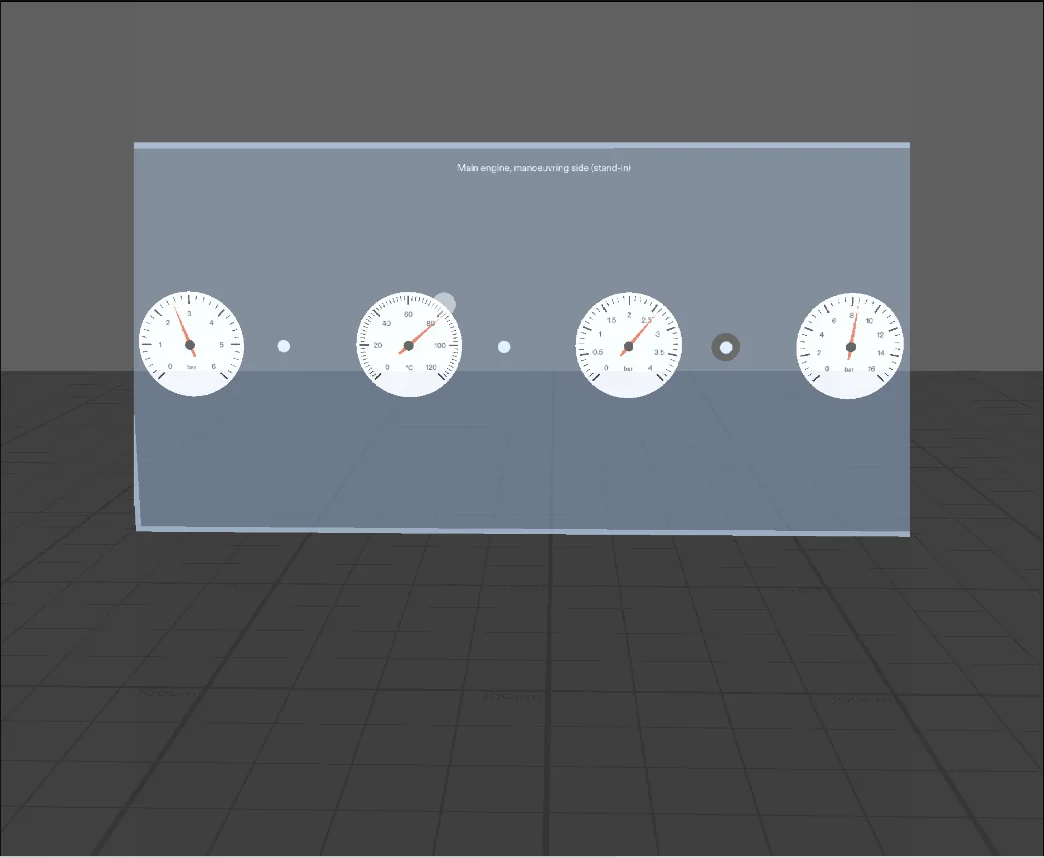
The station. Four dials on a stand-in main engine panel, a dot beside each. Nothing is drawn on the dials until one is read. 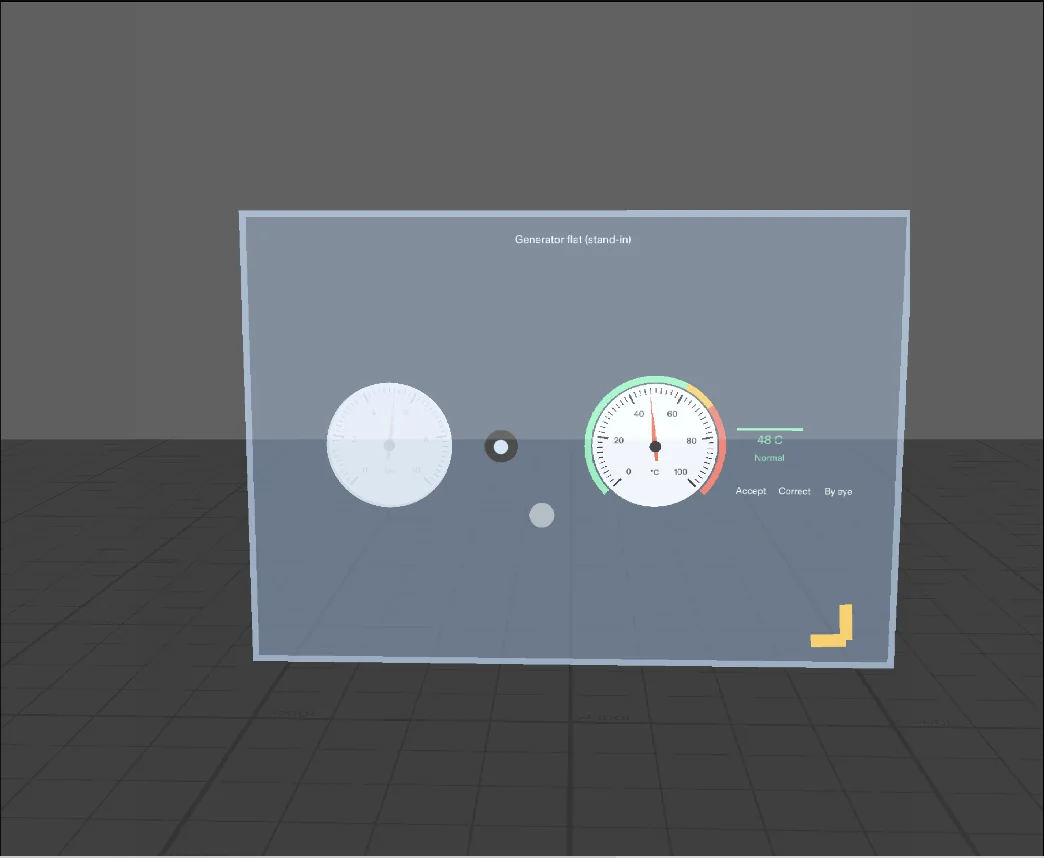
A reading. The tag at the rim gives value, unit and verdict. A thin arc marks the normal band: mint, amber, coral. The glass on the left dial is fogged. 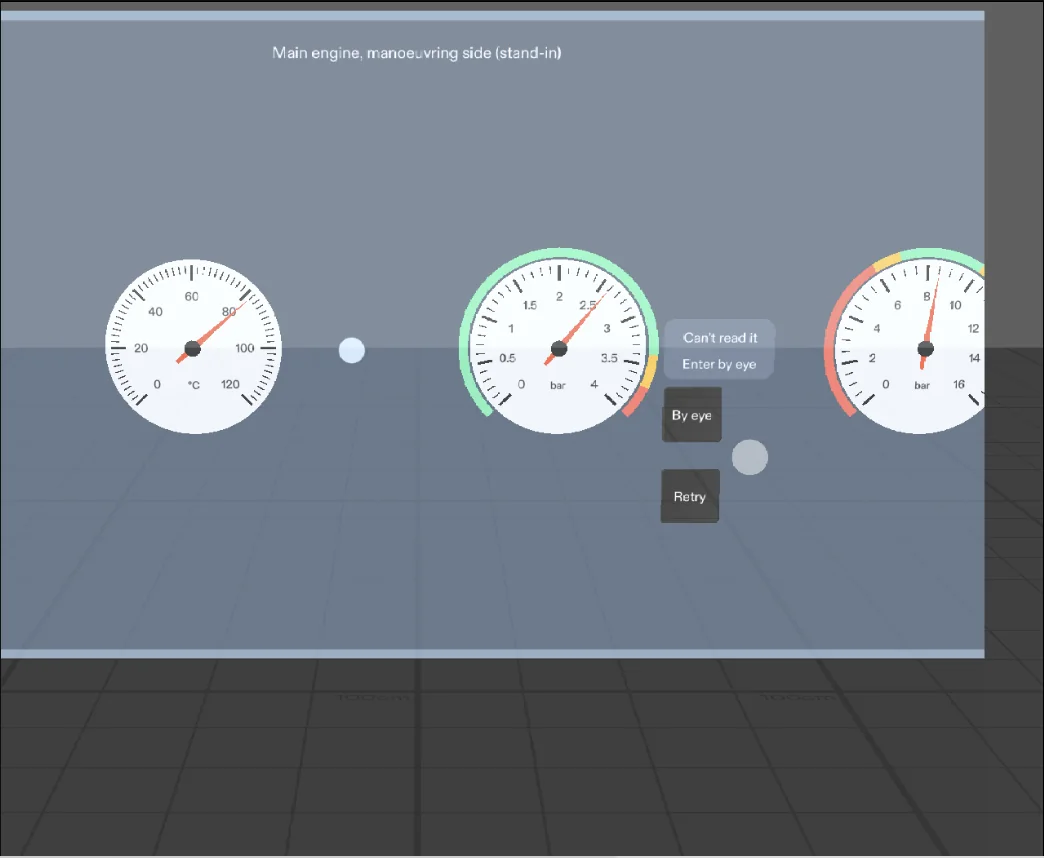
Can't read it. When the reader is not sure, the tag says so and offers By eye or Retry. It never shows a guess as a reading. 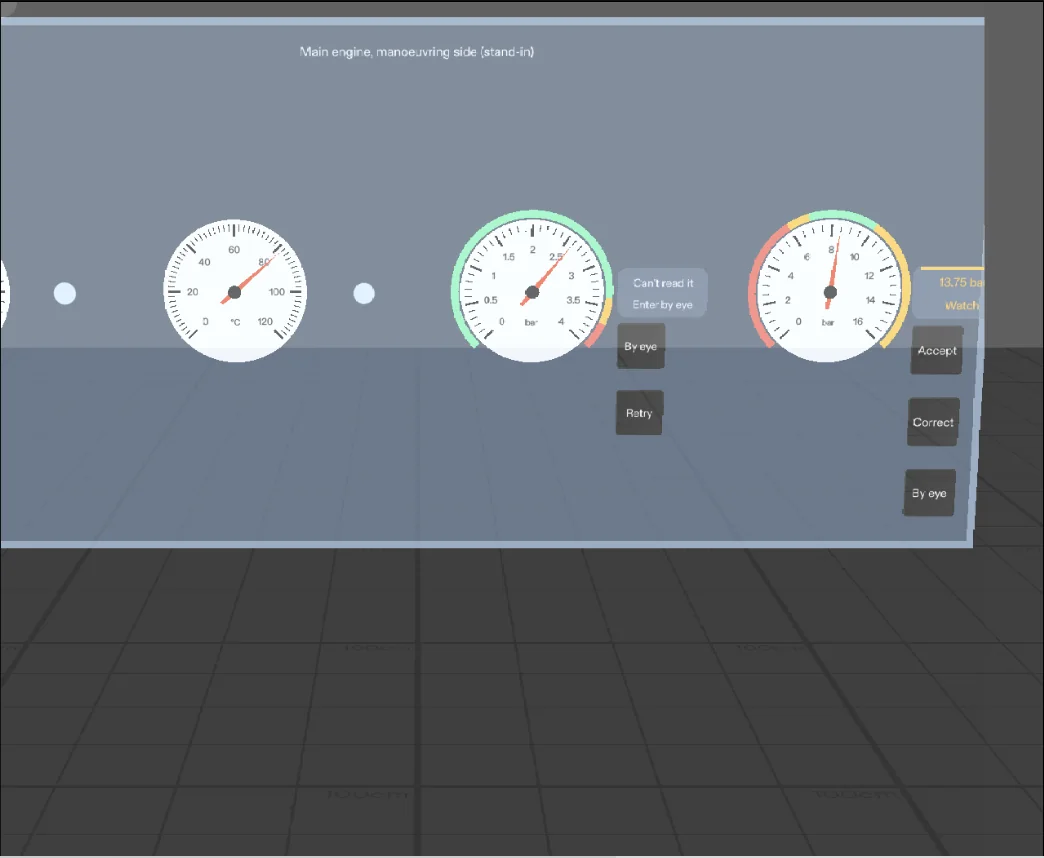
Accept, Correct, By eye. Three large targets in a column, each at least 2 degrees across with 1 degree between them at station distance.
All three strengths, each doing a job.
Shares your view
The camera frame is the evidence.
The reading comes from what the engineer is looking at. A phone needs a free hand, a photo per gauge and a pocket full of oil.
Draws in the world
The tag and the arc sit on the dial.
A tag at the rim, a thin arc for the normal band, a chevron at the edge of view toward the next gauge.
Leaves your body free
Torch, rag, handrail.
A reading happens on a look. The only inputs are large pinch targets, measured at station distance.
What was measured, and where it fell short.
| Check | Result | Where |
|---|---|---|
| Live reads in the preview, overlay hidden | 15 of 34 within 1 tick, median error 1.25 ticks | /proof |
| Fogged dial | read as unreadable 1 of 5 | /proof, a miss |
| Pinch targets at station distance | 39 measured, 0 too small | LEAF extra-pinch-targets |
| Signed round sent to the door | HTTP 201, forced failure 500 shown as Not sent | LEAF extra-send |